
 English (US)
 繁體中文
 日本語
 한국어
 ไทย
 Русский

Hello everyone, I’m Michael Zhang, an avid traveler with a passion for deep, immersive experiences. With a wealth of international travel experience, I am fascinated by uncovering the hidden corners of history and the intricate details of different cultures—especially those of my beloved homeland, China. Today, I invite you to join me in exploring Beijing’s hutongs, a network of ancient alleys that have witnessed centuries of life amid the bustle of a dynamic city. In this article, I’ll guide you through the history, architecture, unique attractions, and fascinating ways to explore these hutongs. I hope that here, you’ll feel the unique charm of Beijing’s hutongs and the rich cultural heritage they represent.
Summary
- What is a Hutong in China?
- Beijing Hutongs: Which Neighborhood Should You Explore?
- Where Does the Name Hutong Come From?
- Where Can You Find Hutongs?
- Beijing Hutongs: The Record-Holders
- How Does a Hutong Get Its Name?
- History of Hutongs in China
- Top Things to Do in Beijing Hutongs
- Six Themed Walks Through Beijing’s Hutongs
- 1. Drum Tower – North Luogu Lane – Yandai Xiejie – Shichahai: Old City and Lake Views
- 2. Yonghe Temple – Guozijian Street – Wudaoying: Temple and Historic Learning
- 3. Dongjiaominxiang – Xixinglong Street – Sanlihe: Legation Architecture and Street Photography
- 4. Qianmen – Dashilar – Yangmeizhu Xiejie – Liulichang: Old Shops and Creative Streets
- 5. Niujie – Fayuan Temple – Lanman Hutong – Xuannan Bookstore: Food and Xuannan Culture
- 6. Lu Xun Museum – White Pagoda Temple – Temple of Ancient Monarchs: Xicheng History
- How Long to Spend in the Hutongs: Kids and Easy-Paced Walks
- Where to Eat, Shop, and Take Photos Along the Hutongs
- How to Reach the Hutong Walks and Where to Finish
- Tips for Visiting Beijing’s Hutongs
- Recommended Beijing Hotels for Exploring the Hutongs
- How to plan your Beijing trip
What is a Hutong in China?
A hutong is a narrow street or alley that runs between main roads in urban and rural areas, often just wide enough for a single car to pass. Hutongs are integral to Beijing’s transportation network but are also a distinct part of the city’s unique character. Depending on their accessibility, hutongs are classified as “dead-end” (with only one entrance that opens into residential areas) or “through-street” hutongs (which connect two or more main roads). While hutongs are especially famous in Beijing, similar streets in Suzhou are known as “xiangnongs.”

Beijing Hutongs: Which Neighborhood Should You Explore?
Beijing’s hutongs are connected residential lanes and courtyard-house neighborhoods in the old city, not a single attraction with one entrance. For a first visit, I recommend picking one area based on what interests you instead of trying to cross every hutong district in a day.
- Drum Tower and Shichahai: old-city lanes, towers, and lakeside views.
- Yonghe Temple, Guozijian Street, and Wudaoying: temples, historic learning, cafés, and small design shops.
- Dongjiaominxiang and the Qianmen area: historic legation-era architecture and southern old-city streets; treat them as separate walking segments.
- Qianmen, Dashilar, Yangmeizhu Xiejie, and Liulichang: old storefronts, creative shops, and traditional books and art.
- Niujie, Fayuan Temple, and Lanman Hutong: halal-style neighborhood food and Xuannan cultural streets.
- Lu Xun Museum, White Pagoda Temple, and the Temple of Ancient Monarchs: Xicheng history and photography around the white pagoda.
You can walk the public lanes themselves; temples and museums along a route have their own admission arrangements. I’ll compare the walking routes, shorter options, places to pause, and convenient subway start and end points below.
Where Does the Name Hutong Come From?
The term “hutong” originated from the Mongolian word “gudum,” which means “water well.” During the Yuan Dynasty, nearly every courtyard residence in Beijing had its own well, which symbolized community and life. As the Yuan capital was designed, rows of residential streets became known as “huduon,” or “streets of wells” in Mongolian, which evolved over time into “hutong,” the term still used today.
Where Can You Find Hutongs?
Beijing is home to thousands of hutongs, with most of them dating back to the Yuan, Ming, and Qing Dynasties in Chinese history. Many of these hutongs were established during the 13th century Yuan Dynasty. Typically, hutongs run east to west and are generally less than nine meters wide. The structures on either side of a hutong are often siheyuan, or courtyard houses, which are arranged in a four-sided, symmetrical layout. These courtyard houses, positioned side by side with narrow alleyways in between, create the interconnected passageways that define hutong neighborhoods.
In the following sections, I’ll highlight some of the best hutongs and routes for you to explore, giving you a taste of Beijing’s history, architecture, and local life.
Beijing Hutongs: The Record-Holders
Some hutongs in Beijing stand out for their unique characteristics, holding titles for their extraordinary features:
- Longest Hutong: Dongjiaominxiang, approximately 1,552 meters long.
- Shortest Hutong: Yichidajie is the shortest, stretching just 15.2 meters.
- Widest Hutong: Lingjing Hutong, with a maximum width of 32.18 meters, is the broadest.
- Narrowest Hutong: Qianshi Hutong in the Dashilar area is the narrowest, with a width of only 0.44 meters at its slimmest point.
- Hutong with Most Turns: Jiuwan Hutong, true to its name, has 19 twists and turns.
- Oldest Hutong: Zhuanta Hutong, dating back to the Yuan Dynasty, is one of Beijing’s oldest.
How Does a Hutong Get Its Name?
Hutong names in Beijing have fascinating origins. Here are some common ways they’re named, along with examples that illustrate each method:
Descriptive Landmarks
Many hutongs are named after distinctive physical features, showcasing Beijing locals’ straightforward and humorous nature. For instance, a wider hutong might simply be called “Wide Street” (Kuanjie), while a narrow one is called “Narrow Lane” (Jiadao). Similarly, hutongs with a unique curve or shape often reflect that in their names, such as “Box Lane” (Hezi) for a rectangular alley or “Trumpet Alley” (Xiaolaba) for a lane that starts narrow and widens. Others like Tangzi Hutong, Shihu Hutong, and Baishu Hutong (now Baishun Hutong) are named after local landmarks or memorable features.
Geographic Landmarks
Historical structures like city gates, temples, and bridges were popular markers for naming hutongs. Examples include Xizhimen Inner and Outer Streets, Qian and Houyuanensi Hutongs, and the famous Dashilar, which means “big fence” in the Beijing dialect. These names often referenced significant landmarks, helping people locate the hutongs with ease.
Trees and Plants
Some hutongs take their names from trees commonly found in the area. For instance, Liushu Hutong (Willow Tree Hutong), Zaolin Hutong (Date Forest Hutong), and Chunsu Hutong (Ailanthus Hutong) all reflect the local flora.
Direction and Location
To make navigation easier, hutongs often incorporate directional indicators, such as east, west, south, and north, into their names. Examples include Dongtangen Hutong, Xihongmen Hutong, Nan Yueya’er Hutong, and Bei Banbi Hutong. These names make it easier to identify each hutong’s relative position within the neighborhood.
Beijing Dialects
Local dialects and slang often influence hutong names, adding a playful touch to their identities. Names like Beiyin’er Hutong, Qudeng’er Hutong, and Gagahutong carry strong Beijing accents, making them truly unique to the city.
Auspicious Wishes
Hutongs often bear names that convey hopes for prosperity, happiness, and longevity. For example, “Lucky Alley” (Xiqing Hutong), “Joyful Alley” (Xique Hutong), and “Longevity Alley” (Shouzhang Hutong) reflect the optimistic spirit of local residents. Other names like Ping’an (Peaceful) and Anfu (Fortunate) Hutongs showcase residents’ aspirations for peace and well-being.
Government or Official Institutions
Certain hutongs take their names from government offices and official residences, such as Lumicang Hutong, Xixiku Hutong, and Gongyuan Hutong. Some are named after titles and offices held by notable residents, such as Yongkang Hou Hutong (named for the title of Yongkang Marquis) and Wuding Hou Hutong.
History of Hutongs in China
Hutongs are an ancient and iconic feature of Beijing, dating back to the Yuan Dynasty. At that time, the capital city, known as Dadu, was designed in a grid layout inspired by the principles of the Bagua, a mystical symbol. This layout organized neighborhoods like a checkerboard, and hutongs naturally developed as narrow pathways connecting these residential areas.
During the Ming Dynasty, Beijing underwent further planning, and hutongs became even more standardized. By the Qing Dynasty, hutongs had evolved into a central part of Beijing’s cultural identity, with many distinct hutongs appearing across the city.
In the years following China’s opening to the world, Beijing’s hutongs have seen both preservation and modernization efforts. Some historically significant hutongs have been designated as protected heritage sites, becoming symbolic of the city’s cultural legacy.
Top Things to Do in Beijing Hutongs
Hutong Culture Walks
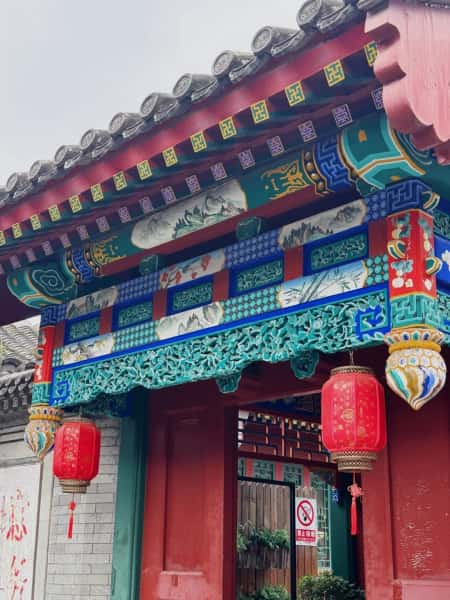
The hutongs in Beijing’s Dongcheng and Xicheng Districts offer the deepest insight into the city’s local charm. Strolling through hutongs like those in the Dongsi area gives you a taste of old Beijing life, architecture, and the historical atmosphere dating back to the Yuan, Ming, and Qing Dynasties. This area is ideal for learning about courtyard houses (siheyuan) and the native plants of the hutongs.
- Exploring Traditional Gates: Siheyuan gates vary by level and type, with distinctions like Wangfu (Royal Mansion), Guangliang, and Jinmen gates. The homes of the Che Prince and Wang Mintong in Dongsi are examples of these gate styles.
- Visiting the Hutong Museum: Located on Dongsi Sitiao, the Hutong Museum showcases traditional siheyuan architecture and features intricate designs like the hanging flower gate. The museum also offers a souvenir stamp station for travelers.
- Discovering Hutong Flora: Common plants in hutongs include locust trees, jujube, gingko, and the native Chinese toon tree. Residents grow an array of flowers and vegetables, from peppers to okra.
Suggested Route: Dongsi Santiao (Che Prince’s Residence) ➔ Dongsi Sitiao (Hutong Museum) ➔ Dongsi Liutiao (Gardening Station)
Biking Through the Hutongs
Riding a shared bike through Beijing’s hutongs is an excellent way to experience the charm of old Beijing up close. Here are a few routes, each with its own unique highlights:
- Route 1: Into the Heart of Bustling Beijing (6.2 km)
- Route: Beihai North ➔ Shichahai ➔ Drum Tower ➔ Song Qingling’s Former Residence ➔ Prince Gong’s Mansion ➔ Beihai North
- Highlights: Switch between bustling streets and peaceful alleys to experience the dynamic mix of modern city life and historic culture.
- Route 2: Night Ride on Chang’an Avenue (6.5 km)
- Route: Wangfujing ➔ East Chang’an Avenue ➔ South Pool Alley ➔ North Pool Alley ➔ West Chang’an Avenue
- Highlights: View the illuminated beauty of Tiananmen Square at night and soak in the magnificent mix of ancient and modern. Note: the Forbidden City is unlit after dark, so bring a flashlight if needed.
- Route 3: Exploring Hutong Life (8 km)
- Route: Imperial College ➔ Nanluoguxiang ➔ Mao’er Hutong ➔ Jingshan Park ➔ Forbidden City
- Highlights: Get a real sense of local Beijing life—from the smoke rising from courtyard homes to the calls of street vendors, each scene embodies the warmth of traditional city life.
- Route 4: Academic Circle (23 km)
- Route: National Library ➔ Beijing Foreign Studies University ➔ Renmin University ➔ Peking University ➔ Tsinghua University ➔ Beihang University ➔ National Library
- Highlights: A route that passes some of Beijing’s most prestigious universities, offering a taste of campus life and popular Beijing street food around each school.
- Route 5: Cycling the Second Ring Road (38 km)
- Route: Ditan ➔ Ritan ➔ Longtan Lake ➔ Temple of Heaven ➔ Taoranting ➔ Grand View Garden ➔ Yuetan
- Highlights: This route circles the Second Ring Road, with scenic stops at Beijing’s parks—a peaceful way to enjoy the city’s natural spaces and unwind.

Hutong Walking Tours
These hutong walking routes reveal Beijing’s hidden beauty and stories. You can choose a route based on your hotel’s location for the most convenient experience.
- Route 1: Sanjing Hutong ➔ Yangwei Hutong ➔ Tea Hutong ➔ Qudeng Hutong ➔ Dashilar West Street ➔ Cherry Slant Street ➔ Iron Tree Slant Street ➔ Liulichang Street ➔ Beijing Huguang Guild Hall ➔ Ji Xiaolan’s Residence
- Route 2: Shichahai A2 Exit ➔ Yandai Xiejie ➔ Drum Tower ➔ Xiaoshabei Hutong ➔ Yinding Bridge ➔ Sugar House Café ➔ Deheyou Wharf ➔ Lotus Wharf ➔ Front Sea West Bank ➔ Fire Temple ➔ Metro Station
- Route 3: Yonghegong Lama Temple Station Exit F ➔ Confucius Temple ➔ Imperial College ➔ Wudaoying Hutong ➔ He Burger ➔ School (livehouse) ➔ Sanyuanmeiyuan ➔ Beiluoguxiang
- Route 4: Gulou Dajie Metro Station Exit G ➔ Yu Ge Hutong ➔ Baochao Hutong ➔ Huayuan Hutong ➔ Beiluoguxiang ➔ Liulisi Hutong

Six Themed Walks Through Beijing’s Hutongs
I would choose one of these six walks as the backbone of a visit, then add a museum, meal, or another neighborhood only when it matches your interests.
1. Drum Tower – North Luogu Lane – Yandai Xiejie – Shichahai: Old City and Lake Views
- Best for: A first-time hutong walk that combines old neighborhoods with lake scenery.
- Follow this route: For the full walk, start at Gulou Dajie subway station, continue toward the Drum Tower and North Luogu Lane, then follow Yandai Xiejie to Yinding Bridge and the Shichahai waterfront. The lanes show residential Beijing; the bridge and lake add a different view.
- Shorter or longer choice: For less walking, enter from Shichahai station and concentrate on Yandai Xiejie, Yinding Bridge, and the lakeside. Extend toward Lotus Market if you want to keep exploring.
- Finish and return: End around Shichahai and use a nearby subway station for the return instead of backtracking along the entire walk.
2. Yonghe Temple – Guozijian Street – Wudaoying: Temple and Historic Learning
- Best for: Travelers interested in temple architecture, Confucian learning, and a relaxed café stop.
- Follow this route: Start at Yonghegong subway station. Combine Yonghe Temple with Guozijian Street and, if you choose to go inside, the Confucius Temple and Imperial College Museum. Continue to Wudaoying for smaller shops and cafés.
- Shorter or longer choice: Keep the walk to Guozijian Street and Wudaoying for a short neighborhood visit; include temple or museum interiors for a longer cultural visit. Dongsi is another district, not a quick extra alley along this route.
- Finish and return: Finish around Wudaoying or Guozijian; use the subway if continuing separately to Dongsi or the Guijie dining area.
3. Dongjiaominxiang – Xixinglong Street – Sanlihe: Legation Architecture and Street Photography
- Best for: Architecture fans who want both former legation streets and quieter southern old-city scenes.
- Follow this route: Explore the facades along Dongjiaominxiang first. Separately, follow Xixinglong Street and the Sanlihe Park area for hutong views and photographs around the Qianmen neighborhood.
- Shorter or longer choice: Choose either the Dongjiaominxiang buildings or the Xixinglong–Sanlihe street segment for a shorter visit; link the two segments by transit if you want both.
- Finish and return: Finish each segment in its own area. The stops are not one short, continuous alleyway, and the photo route does not assume access to historic building interiors.
4. Qianmen – Dashilar – Yangmeizhu Xiejie – Liulichang: Old Shops and Creative Streets
- Best for: Anyone choosing between traditional storefronts, handmade goods, design shops, and calligraphy-related shopping.
- Follow this route: Start around Qianmen, browse Dashilar, move toward Yangmeizhu Xiejie for smaller creative shops, and continue to Liulichang if books, paintings, and writing materials appeal to you.
- Shorter or longer choice: Keep it to Qianmen and Dashilar for a shorter shopping walk; include Yangmeizhu and Liulichang for a fuller outing. Qianmen street photography after dark is an optional finish.
- Finish and return: Return via the Qianmen area, or end around Liulichang rather than reversing the entire shopping route.
5. Niujie – Fayuan Temple – Lanman Hutong – Xuannan Bookstore: Food and Xuannan Culture
- Best for: Travelers who want local food together with historical streets rather than another shopping-only route.
- Follow this route: Begin in the Niujie neighborhood for halal-style snacks and food, then continue toward Fayuan Temple and Lanman Hutong to see the older Xuannan neighborhood.
- Shorter or longer choice: Niujie food stops alone make a shorter outing; for a fuller cultural route, add the historic streets and extend to Xuannan Bookstore’s Liulichang location.
- Finish and return: Treat this as its own neighborhood outing; end at Lanman Hutong or use a separate transfer for the bookstore extension.
6. Lu Xun Museum – White Pagoda Temple – Temple of Ancient Monarchs: Xicheng History
- Best for: History lovers and photographers looking for the white pagoda framed by red walls.
- Follow this route: Approach from the Fuchengmen or Xisi area. Combine the Lu Xun Museum area, lanes east of White Pagoda Temple, and the Temple of Ancient Monarchs as separate historical stops.
- Shorter or longer choice: For less walking, concentrate on the lanes by White Pagoda Temple and the red-wall views; add museum or temple interiors only if you want a longer historical visit.
- Finish and return: Finish near Fuchengmen or Xisi and leave by subway rather than treating every museum as a required entry stop.
How Long to Spend in the Hutongs: Kids and Easy-Paced Walks
I would set the time based on the number of neighborhoods and indoor stops, not on a supposed single “hutong ticket” or a fixed visiting circuit.
Choose a Short Walk or a Half-Day Outing
For a compact introduction, allow about an hour for the streets around the Drum and Bell Towers, or focus on Wudaoying and Guozijian as one neighborhood. A half day works better when you add a temple, museum, lunch, or café. If you want several indoor cultural stops and an unhurried meal, devote most of the day to one themed area instead of attempting all six routes. These are my planning options, not required attraction visiting times.
Walking Beijing‘s Hutongs With Children
With kids, I would choose the Guozijian cultural walk if they enjoy historical displays, the Qianmen–Yangmeizhu short route for small shops, or the White Pagoda Temple lanes for old-city photographs. Pick just one district, with an indoor or shaded break between outdoor sections. In summer, avoid a long continuous outdoor walk from noon to 3 p.m.; use that period for a museum, meal, or café instead. Museum entry is an optional part of the plan, not a requirement for the street walk.
Seniors, Lower Stamina, and Places to Stop
For an easier pace, I would stay within one district and turn back at a useful stopping point rather than following the longest cross-neighborhood route. Wudaoying offers cafés, the Qianmen shopping streets offer food stops, and the Shichahai waterfront gives a natural place to pause beside the lake. Choose a shorter loop near those stops and continue by subway when changing districts; For wheelchairs or strollers, I would keep to a short route on the wider main streets and leave narrow side alleys off the required path.
Where to Eat, Shop, and Take Photos Along the Hutongs
I recommend deciding what you want to do along the walk—eat, browse, or photograph—before choosing the neighborhood.
Food and a Rest Stop
Choose Niujie for halal-style Beijing neighborhood snacks. On the Yonghe Temple route, a separate connection toward Guijie works for a restaurant-focused extension. Around Shichahai, the lakeside setting is an attractive place to pause or plan a meal; I would not squeeze all three food areas into the same walk.
Creative Shops or Traditional Arts
Wudaoying, Yangmeizhu Xiejie, and Xixinglong Street suit a stroll among small design, craft, and café spaces. For paintings, books, and traditional writing supplies, I would choose Liulichang instead. Select the area by the type of shop you want, not by an undifferentiated “shopping street” label.
Three Different Street Photography Styles
For former diplomatic buildings and Western-style street facades, walk Dongjiaominxiang. For a red-wall composition with the white pagoda, choose the lanes east of White Pagoda Temple. For lively commercial streets and a night-street atmosphere, choose Qianmen and Dashilar. All three are outdoor street-view choices; they do not depend on entry to historic building interiors.
How to Reach the Hutong Walks and Where to Finish
There is no single entrance to Beijing’s hutongs. I would match the subway approach and exit area to the walk instead of returning to the starting point by default.
| Themed walk | Where to begin | Where to end or connect next |
|---|---|---|
| Drum Tower and Shichahai | Full route: Gulou Dajie station; shorter route: Shichahai station. | Finish around Shichahai; take a nearby subway for the return. |
| Yonghe Temple, Guozijian, and Wudaoying | Yonghegong station; follow Guozijian Street toward Wudaoying. | Finish near Wudaoying or Guozijian; use the subway for separate Dongsi or Guijie plans. |
| Dongjiaominxiang and southern old city | Begin on Dongjiaominxiang for historic facades; start a separate Qianmen-area segment at Xixinglong Street. | End each segment locally; use transit between Dongjiaominxiang and Xixinglong–Sanlihe. |
| Qianmen, Dashilar, Yangmeizhu, and Liulichang | Begin around Qianmen and continue into Dashilar. | Return toward Qianmen, or finish near Liulichang if you add traditional art shops. |
| Niujie and Xuannan | Enter the Niujie area from the Niujie or Caishikou side. | Finish around Lanman Hutong; Xuannan Bookstore in Liulichang is an optional continuation. |
| Lu Xun Museum and White Pagoda area | Approach from Fuchengmen or Xisi. | End in the same Xicheng area, with a subway return instead of a full backtrack. |
For navigation, I recommend looking up the Chinese place names in Amap or Apple Maps. Set your chosen starting station and final stop as separate destinations in the map so you can follow the walk in one direction.
Tips for Visiting Beijing’s Hutongs
- Wear Comfortable Shoes: Hutong streets are often paved with stone and can require a lot of walking or biking. Good shoes will help you enjoy your visit even more.
- Stay Protected from the Sun: Beijing’s sun can be strong, especially in summer. Bring sunscreen, a hat, and sunglasses to avoid sunburn.
- Explore During the Day: While Beijing is generally very safe, some hutong areas are dimly lit. For a safer experience, visit during daylight hours or when there’s plenty of natural light.
- Respect Local Residents: Hutongs are home to many locals. Be mindful when taking photos, avoiding direct shots of private doors or courtyards, and try to keep noise levels down.
- Bring Cash or Mobile Payment Options: Some small shops or stalls may not accept credit cards, so having some cash or mobile payment apps like Alipay or WeChat can make transactions easier.
Recommended Beijing Hotels for Exploring the Hutongs
These five selected hotels are convenient bases for exploring Beijing as a whole, including a hutong visit as part of a wider city itinerary. Most are in the Qianmen or central-Beijing travel area rather than immediately beside Shichahai, the Drum Tower, or Wudaoying. I would choose a hotel for your full sightseeing plan and connect to the particular hutong neighborhood by subway or car.
CitiGO Hotel Beijing Qianmen Street
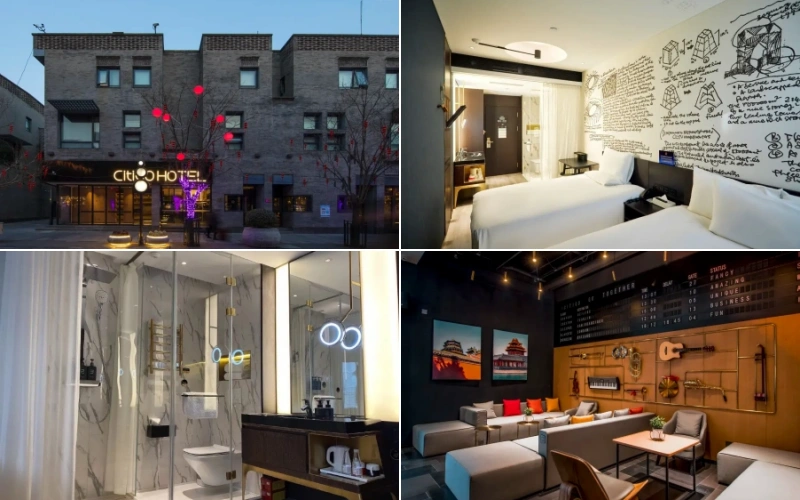
- Location: 2-minute walk to Zhushikou Subway Station
- Price per night: 430 CNY
- Check Rates:Trip.com Specials, Agoda Deals
- Rating: Trip 9.6 / Agoda 9.6
- Special Amenities: Laundry room, robot room service, family rooms
The hotel sits in the core section of Qianmen Street, about a two-minute walk from Zhushikou Subway Station, which makes getting around very efficient. From here, walking or taking the subway to Tiananmen Square and the Forbidden City feels straightforward. Qianmen Street and Dashilan are right nearby, so you can stroll, shop, and try local snacks well into the evening. There are also convenience stores and coffee shops downstairs, which makes grabbing drinks or quick supplies easy.
Rooms are clean and well-organized, with new facilities and comfortable latex mattresses. Toiletries are good quality. Free laundry and drying are especially practical during a trip. Breakfast runs for long hours, with rotating options each day, and the freshly cooked wontons stand out. In the evening, there is also a simple late-night snack, which feels like a nice bonus when returning to the hotel.
THE YARD HOTEL BEIJING, Qianmen Avenue

- Location: 3-minute walk to Zhushikou Subway Station
- Price per night: 434 CNY
- Check Rates:Trip.com Specials, Agoda Deals
- Rating: Trip 9.2 / Agoda 9.1
- Special Amenities: Laundry room
The hotel is located directly on Qianmen pedestrian street, just a short walk from Zhushikou Subway Station. Staying here saves a lot of walking time. Qianmen, Dashilan, and many time-honored local restaurants are either downstairs or within easy walking distance, so you can shop and eat late without rushing. Taking the subway to Tiananmen Square or the Forbidden City is also smooth, without the need for repeated transfers.
Rooms are tidy and clean, with a Republic-era design style that gives the space some character. The rooms are not large, but good natural light and acceptable soundproofing keep them comfortable. Bedding feels good, hot water comes quickly, and resting after a full day of sightseeing is easy. Service is friendly, check-in and extended stays run smoothly, and the laundry room is practical for stays of several days.
Manxin Hotel Beijing Tiananmen Qianmen Street
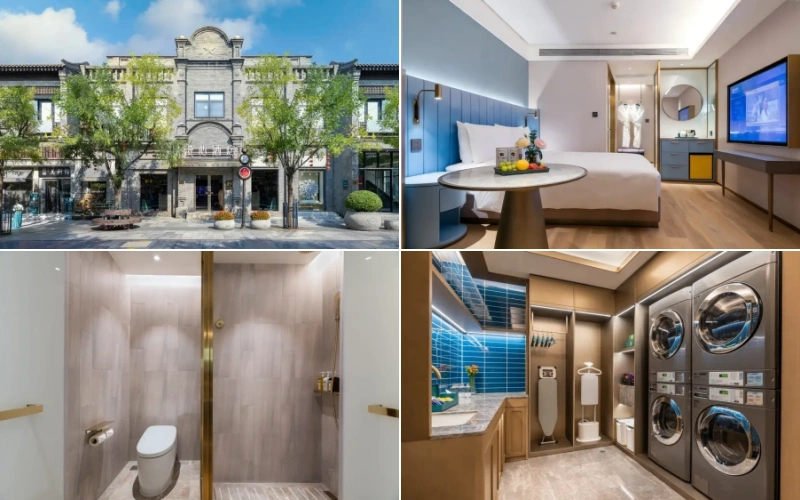
- Location: 7-minute walk to Zhushikou Subway Station, 10-minute walk to Qianmen Subway Station
- Price per night: 591 CNY
- Check Rates:Trip.com Specials, Agoda Deals
- Rating: Trip 9.8
- Special Amenities: Robot room service, laundry room, family rooms
The hotel sits in the middle section of Qianmen Street. Once you step outside, you are already in the Dashilan and Xianyukou area, where food options and traditional restaurants are densely packed. You can walk to Tiananmen Square, and both Zhushikou and Qianmen subway stations are within reasonable distance. Taking the subway to other parts of the city or planning longer day trips is convenient. Even though the hotel is in a popular tourist area, it feels quiet once inside, thanks to well-designed internal layout.
Rooms are clean and neatly maintained, with a practical layout and intuitive smart features that make the stay feel relaxed. Overall cleanliness is well controlled, with no unpleasant odors on entry. The bed and linens support good rest. Service is a strong point here, as the front desk responds quickly and stays friendly, including when handling requests from families with children. Daily housekeeping and request handling are both timely.
Crystal Orange Beijing Qianmen
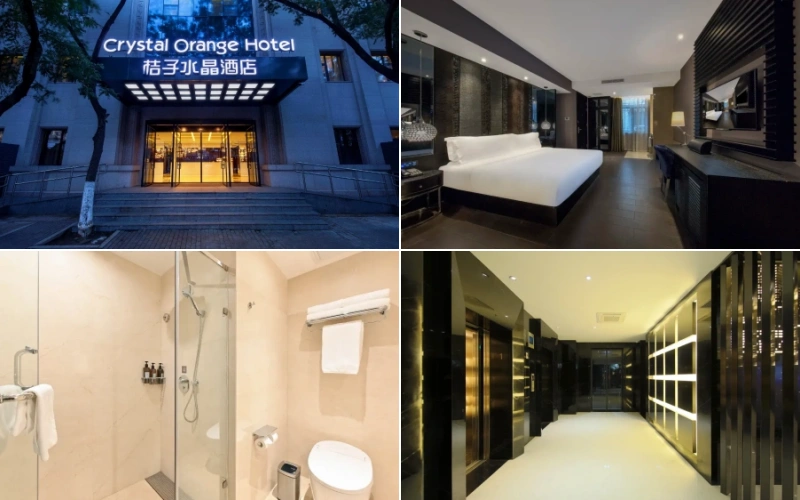
- Location: 10-minute walk to Zhushikou Subway Station
- Price per night: 617 CNY
- Check Rates:Trip.com Specials, Agoda Deals
- Rating: Trip 9.7 / Agoda 9.6
- Special Amenities: Robot room service, laundry room, family rooms
The hotel is located within the first ring road around Qianmen, yet the immediate surroundings feel relatively quiet. It takes about ten minutes to walk from Zhushikou Subway Station. This area is not the most crowded part of Qianmen, but it has a strong local feel. Turning into nearby lanes leads you to many old Beijing snack spots. Moving toward Qianmen, Dashilan, or Tiananmen Square is also smooth, whether you walk, cycle, or take the subway.
For a central location, the rooms feel fairly spacious, with good natural light and ventilation. Soundproofing adds to a sense of comfort, and the beds and linens support solid sleep. Food delivery can be sent upstairs by robot, which makes daily routines easier. Service leans toward detail-oriented, responses are quick, and housekeeping stays consistent during longer stays.
Beijing Wanda Moments Hotel
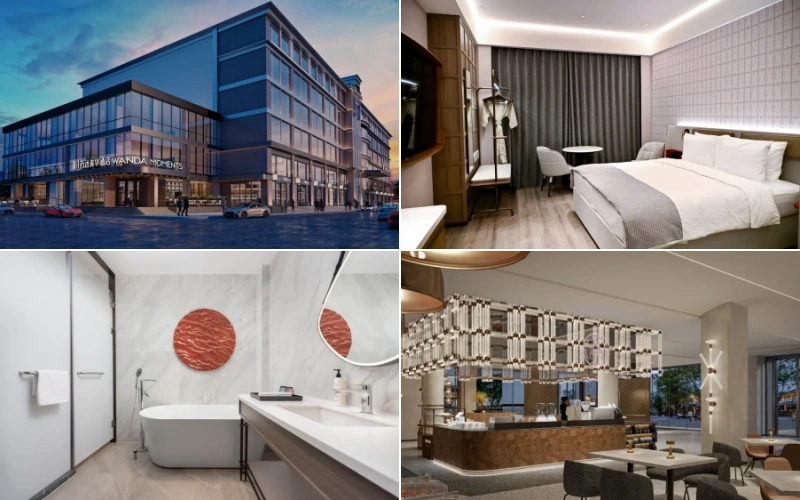
- Location: 3-minute walk to Zhushikou Subway Station
- Price per night: 677 CNY
- Check Rates:Trip.com Specials, Agoda Deals
- Rating: Trip 9.4 / Agoda 8.6
- Special Amenities: Robot room service, laundry room, gym
The hotel sits in the core Qianmen area, with Zhushikou Subway Station right outside. Both Line 7 and Line 8 are directly accessible, which makes moving around very efficient. You can walk to Qianmen Street and Dashilan, and heading toward Tiananmen Square or the Forbidden City also feels manageable on foot. Taking the subway to Wangfujing, Xidan, the Temple of Heaven, or other attractions stays straightforward, without unnecessary detours.
Rooms feel relatively spacious for the Second Ring Road area, with good light and a comfortable sense of space. Beds and bedding feel supportive, making it easy to rest well. Cleanliness is well maintained, facilities are complete, and daily use feels smooth. Communication before and after check-in runs efficiently, and staff actively help when needed. Breakfast offers stable quality with good variety, while the laundry room and gym add practical value. Food delivery can also be sent upstairs by robot.
How to plan your Beijing trip
Most first-timers spend 2–3 days in Beijing to cover the major highlights. If you’d like to add a theme park day, plan 5 days to include Universal Studios Beijing. Here are our most popular private tour options:
- Beijing 5-Day Private Tour (with Universal Studios Beijing) — 5-day private Beijing tour with Universal Studios and top landmarks like the Great Wall and Forbidden City.
- Beijing 4-Day Private Tour— 4-day private Beijing tour with the Great Wall and Forbidden City.
- Beijing 3-Day Private Tour — 3-day private Beijing tour with the Great Wall, Forbidden City, and more iconic sights.
- Beijing 2-Day Private Tour — 2-day private Beijing tour with the Great Wall, Forbidden City, and Summer Palace.
Essential Beijing Travel Resources
- Comprehensive Beijing Travel Guide 📖
- Beijing Travel Recommendations 🏙️
- Hotel Recommendations 🏨
- Transportation Guides ✈️ 🚇 🚄 🚆
- Essential Travel Tips & Tools 🗺️ 🍜 📱 💸 🌤️ 💊
- 🗺️ Beijing Maps
- 🍜 Beijing Food and Dining Guide
- 🍜 Peking Duck in Beijing Guide
- 📱 Essential Travel Apps
- 💸 China Tax Refund Guide
- 🌤️ Beijing Weather Guide
- 💊 Essential Medicines for Traveling
- 🛍️ Travel Deals China
- 🔌 China Plug Types and Power Adapter Guide
- 📶 How to Use eSIM China
- 🧳 Packing List and Travel Checklist